
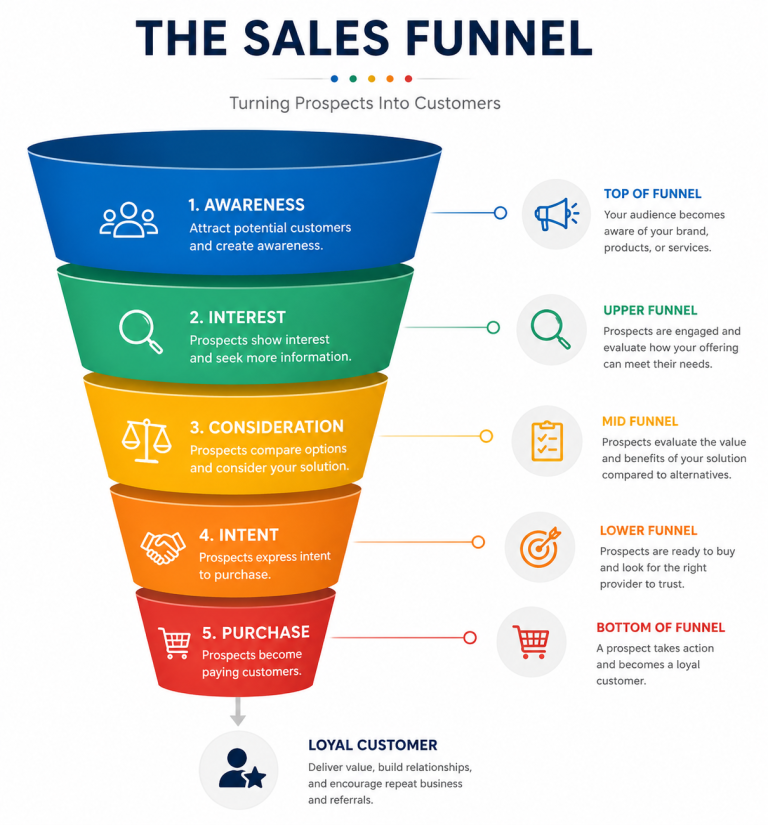
I love sales funnel development!
Sales funnel development is the discipline of turning a first-time visitor into a loyal, repeat customer through a deliberate sequence of connected steps. If you run a small business, you have probably spent money to earn attention, watched people browse, and then lost them with no clear sense of why.
The most respected marketers of the past sixty years, from direct-response pioneers to today’s funnel designers, all reached the same conclusion: people rarely buy on first contact, so you need a structure that carries each person from curiosity to commitment. This guide hands you that structure, drawn from the frameworks working professionals actually use.
You do not need a large team or an expensive software stack to begin. What you need is a clear plan, an honest inventory of what you already own, and the discipline to build each stage in the right order.
This blueprint that borrows from the strongest thinking in the field and then translates that thinking into steps you can apply now. By the end, you will understand how to read your assets, map a customer journey, design offers that convert, and measure the numbers that prove your funnel earns money.
Sales funnel development is the practice of matching the right message and the right offer to the right person at the right moment.
Eugene Schwartz, whose 1966 book Breakthrough Advertising still shapes how professionals write, argued that every prospect sits at a different level of awareness about their problem and your solution. Some people do not yet know they have a problem, while others are ready to buy and need only a nudge. Schwartz observed that “the more aware your market, the easier the selling job,” which means your funnel must meet each person where that person already stands.
A funnel is a system that moves a person through stages of growing awareness and trust, offering more value and asking for more commitment at each step. When you design that system on purpose, you stop depending on luck and start depending on a process you can repeat, measure, and improve. That shift from guesswork to method is the real prize, and the rest of this guide shows you how to build the system stage by stage.
Before you start your sales funnel development or build anything, know why and how this work pays off, because funnels are economic drivers. Most small business owners think about a single sale, while seasoned professionals think about the lifetime value of a customer, meaning the total revenue one person brings across the entire relationship. Research summarized by the Harvard Business Review has long shown that keeping an existing customer costs far less than winning a new one, so the back half of your funnel, where repeat purchases live, often holds your real profit.
Here is the strategic point that separates strong funnels from weak ones. Whoever can profitably spend the most to acquire a customer tends to win the market, because that business can outbid rivals for ads, attention, and talent. When your funnel raises the lifetime value of each customer, you earn room to invest more in attracting the next one. To control and reduce customer acquisition costs every step of your funnel must convert at the best rate. A high conversion funnel is the secret to healthy sales profits.
Sales funnel development begins with an inventory of what you have to offer. Many small business owners are sitting on valuable knowledge and without realizing how much that material is worth. Your products, services, pricing, and delivery process are the obvious assets and less obvious ones such as your email list, testimonials, case studies, photos of finished work, and the questions you answer over and over. The U.S. Small Business Administration offers helpful planning resources, and you can review guidance from the SBA as you organize your foundation.
Your intellectual property deserves special attention, because your unique process and solutions can become the message of your funnel. I once worked with a contractor who swore he had nothing to teach, yet his simple method for estimating a remodel became the foundation of his most profitable offer. The same lesson holds for you. You almost certainly know more than you give yourself credit for.
Once you know your assets, you can ask which digital products you could build from them. Alex Hormozi popularized a useful way to judge any offer: perceived value rises when you increase the result a person wants and their belief that they will reach that result, and value rises further when you reduce the time and effort the person must spend to get there. A well-designed digital product, whether a checklist, a template, or a recorded class, improves every one of those terms by handing someone a faster, easier route to a result they already want.
The skill lies in matching each product to a stage of the journey rather than building everything at once. A free checklist suits a cautious newcomer, a low-priced template or mini-course suits someone who wants a small win, and a full course or done-for-you service suits a committed buyer. Build one entry-level product and one core offer first, watch how people respond, and expand only when real demand tells you to. Acting as your own sales funnel creator, you let evidence rather than enthusiasm decide what you build next.
The most useful map in all of Sales Funnel Development comes from Schwartz’s five stages of awareness, and learning them will sharpen every message you write. A person who is unaware does not yet recognize the problem. Someone problem-aware feels the pain but does not know that solutions exist. A solution-aware person knows a category of fix exists but has not chosen one, a product-aware person knows your offer but has not committed, and a most-aware person is ready to buy and needs only a clear path forward.
When you map your own customer journey against these five stages, you see exactly where people get stuck and what each stage needs from you. The Nielsen Norman Group’s guide to customer journey mapping offers a practical method for charting those moments, and the same thinking applies whether you sell building plans, coaching, or coffee. Early stages call for teaching and reassurance, while later stages call for proof and a simple invitation to act. Match your content to the stage, and your funnel begins to feel less like selling and more like helping.
Russell Brunson, who built one of the best-known funnel software companies, gave small business owners a memorable structure called the value ladder. Picture a ladder where each rung is an offer, starting with something free or inexpensive and climbing toward your most valuable service. Each rung delivers a result that prepares the buyer for the next, so the progression feels natural rather than pushy. Brunson suggests anchoring the ladder to a simple mission statement that names who you serve, the result you deliver, and the method you use, so every offer points toward the same destination.
The bottom rung is not designed to make you rich. The bottom rung exists to attract the right customer and earn trust, which is why professionals often accept little or no profit on a first offer. As trust grows, each higher rung asks for a larger commitment and delivers a larger result, which steadily raises the lifetime value you read about earlier. When your value ladder is clear, you always know what to offer a person next, and your customers always have an obvious way to go farther with you.
Lead generation is the system that turns anonymous traffic into named contacts you can reach again. Email is still one of the most profitable methods of selling and outperforms most all social media.
The mechanism is a fair trade: you offer something genuinely useful, often called a lead magnet, and in return a person gives you an email address and permission to follow up. The strongest lead magnets are specific and quick to consume, because a focused checklist or a short video tends to outperform a long, vague download that nobody finishes.
Hormozi makes a point worth remembering here: the market you choose matters more than the offer or your persuasion skills. A hungry audience with a real problem forgives an imperfect offer, while the most polished funnel struggles in front of people who simply do not care. So aim your entry offer at a specific person with a specific problem, connect your landing page to an email platform that stores each new lead automatically, and keep the page focused on one promise and one action. Acting as your own sales funnel creator, you remove every distraction so the visitor faces a single clear choice.
Some offers deserve more room to teach, and that is where webinar, book, and course funnels earn their place. A webinar funnel invites a person to a class, delivers real value, and then presents a related offer, which compresses a long sales process into a single sitting. Brunson’s well-known webinar script and the teaching approach popularized by educators like Amy Porterfield both work for the same reason: you prove your skill in real time, so the offer at the end feels like a natural next step rather than a cold pitch.
A book funnel uses a low-cost or free-plus-shipping book to attract serious buyers and begin the relationship on solid footing, even when the book itself earns little. A course funnel packages your knowledge into lessons a person can buy and complete at their own pace, which positions you as a teacher and an authority at the same time. Whichever format you choose, keep your promise and your delivery tightly matched, and make sure the offer at the end connects directly to the lesson you just taught.
Not every offer should be available with a single click. When you sell a premium service or a high-touch program where fit truly matters, an application funnel protects both you and the buyer. Instead of asking for payment first, you invite the person to apply or book a call, which gives you a chance to confirm the relationship makes sense before money changes hands.
An application funnel usually opens with a page that explains the offer and the kind of person who benefits most, followed by a short form that asks about goals, budget, and readiness. Those questions quietly screen out poor fits while inviting strong ones forward, and each honest answer prepares you to serve that person well. By the time someone reaches the call, that person has already learned about you and raised a hand, so your role is to listen, confirm fit, and recommend the right path rather than push a sale.
A first sale needs to be a beginning, not an ending, and the nurture and ascension stages are where loyal customers and real profit appear. Nurturing is the steady, generous follow-up, usually by email, that keeps you helpful and present whether or not a person has bought yet. Good nurture content teaches and encourages far more often than the content sells, so your audience looks forward to hearing from you instead of bracing for another pitch.
Ascension is the deliberate practice of inviting happy customers up the next rung of your value ladder. Someone who loved your starter product is the most likely person to enjoy your premium offer, yet many small business owners never extend the invitation. Because you have already earned trust, each additional sale costs far less than the first, which is exactly why the back end of a funnel compounds into dependable revenue over time.
A plan without a schedule rarely becomes reality, so your final task in Sales Funnel Development is to turn this guide into a roadmap. Decide which stage you will build first, set a realistic deadline, and resist the urge to build everything at once. Most businesses get the strongest early results by launching one lead magnet, one nurture sequence, and one core offer, then improving each piece based on real behavior.
Measurement is where modern marketing began. Claude Hopkins, whose century-old work Scientific Advertising taught marketers to test rather than guess, would recognize today’s dashboards as the same idea in newer clothing. Watch a small set of key performance indicators, often shortened to KPIs:
Review these numbers on a regular schedule, change one thing at a time, and let the data point to your next improvement. Patient, measured work beats frantic guessing every single time, and a funnel you refine month after month will outperform any flashy launch that nobody maintains.
To improve sales or action conversions you can split test. A funnel and marketing expert or business coach for sales funnels such as myself can review and evaluate what to split test in your funnel. I have never encountered an optimized funnel, in other words conversions can always be improved. Split testing is ongoing sales funnel development.
Sales funnel development gives your business a repeatable path that turns curious strangers into loyal, repeat customers, and the strongest funnels borrow from decades of proven thinking. You begin with an honest audit of your assets, then package your expertise into digital products that raise value by giving people a faster, easier route to a result they want. From there, you map the journey through the five stages of awareness and build a value ladder that lifts each customer toward your most valuable offer.
The middle and back stages build the machinery and the profit: lead generation that captures contacts, webinar and course funnels that teach and convert, application funnels that protect high-ticket offers, and nurture pathways that turn one sale into many. A clear roadmap and a few honest KPIs keep the whole system improving. Build one stage well, measure the result, and grow from there.
How long does sales funnel development take to build?
You can launch a simple funnel with one lead magnet and one core offer in a few weeks, especially when you use assets you already own. A full value ladder with webinar, course, and application funnels takes longer, often several months, because you add and test one stage at a time. Starting small and improving steadily beats waiting for a perfect, finished system.
Do I need expensive software to start?
No. You can begin with an email platform, a landing page tool, and a way to take payment, and many affordable options bundle those features together. Acting as your own sales funnel creator, you should choose simple tools you will actually use rather than a complex suite that sits unused. You can upgrade once your funnel proves its value.
What is the difference between a sales funnel and a website?
A website is a place people visit, while a funnel is a guided path people follow. A website often lets visitors wander, which suits browsing but weakens selling. A funnel removes distractions and points each person toward one clear next step, so more visitors take action.
Which awareness stage should my funnel target first?
Start with the people closest to buying, often called solution-aware and product-aware, because they convert fastest and fund your growth. Once that part of your funnel works, you can build content for problem-aware and unaware audiences, who take longer to warm up but widen your reach. Matching your message to each stage is the heart of a funnel that converts.
How do I know if my funnel is working?
Watch your conversion rate, your cost per lead, and your customer lifetime value over time. If those numbers improve as you refine each stage, your funnel is healthy. If a number stalls, that stage is the place to focus your next round of testing.
Sales funnel development is not a single trick or a one-time campaign. The work is a thoughtful system that connects every step of your customer relationship, from the first curious click to the loyal repeat purchase years later. When you borrow the best thinking from marketers like Schwartz, Brunson, and Hormozi, then translate that thinking into steps that fit your business, you replace guesswork with a structure you can trust and improve. The reward is a business that grows on purpose rather than by accident.
You already hold most of what you need to begin. Your experience, your past customers, and your hard-won knowledge are the raw materials of a funnel built around your strengths. Start with one stage, measure the result, and keep climbing. Step by step, you will create a path that serves your customers well and brings your business consistent, dependable growth.
Start your sales funnel development. Choose one stage from this guide; your audit, your lead magnet, or your core offer, and commit to building that piece this week. If you want a partner to map the full journey with you, reach out today and let us help you design a funnel built around your goals, your customers, and your strengths.